

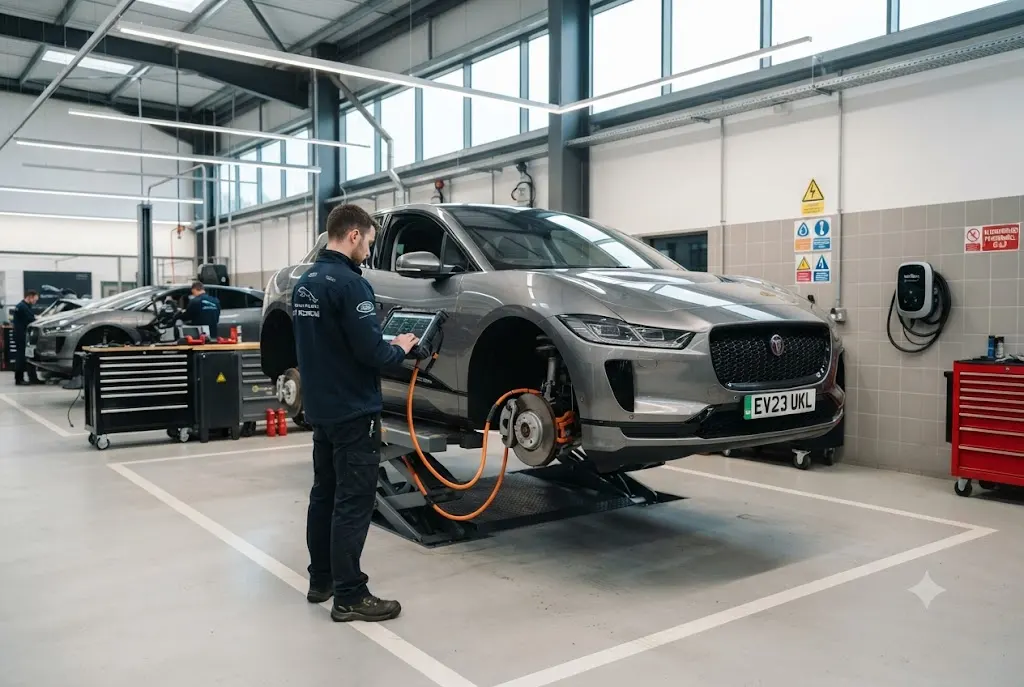
EV servicing is becoming an increasingly important part of the UK automotive aftermarket as more motorists switch from petrol and diesel vehicles to fully electric cars. Although electric vehicles have fewer moving mechanical components than conventional cars, they still require regular inspections, diagnostics, maintenance and safety checks.
For drivers, the biggest change is understanding what actually needs servicing. Electric vehicles do not need traditional engine oil changes, spark plugs or exhaust-system maintenance, but they still rely on brakes, tyres, suspension, steering, cooling systems, charging equipment, software and high-voltage electrical components. For workshops, this creates a new combination of technical skills and equipment requirements.
What Is EV Servicing?
EV servicing covers the inspection, maintenance and diagnosis of a battery-electric vehicle. The exact service schedule varies between manufacturers and models, but common checks can include the high-voltage system, battery condition, charging system, brakes, tyres, steering, suspension, cooling systems, lights and other vehicle safety components.
Modern EVs are also highly dependent on electronic systems and software. Diagnostic checks can therefore be an important part of identifying faults that may not be visible during a conventional mechanical inspection.
Bosch Car Service states that electric vehicles still require regular servicing and highlights battery health checks, brake and tyre inspections, cooling-system maintenance and diagnostics among the relevant areas of EV care.
Why EV Servicing Matters in the UK
The growth of electric vehicle ownership is changing the requirements of the automotive aftermarket. Traditional garages built primarily around internal combustion engines now need to develop new capabilities if they want to serve an expanding EV customer base.
For motorists, this means the choice of service provider deserves more attention than simply finding the nearest garage. A workshop may be experienced with conventional vehicles without having the equipment, training or procedures required for high-voltage EV systems.
The distinction is particularly important when a vehicle requires specialist diagnostics or electrical repairs rather than routine maintenance. A capable EV workshop should understand the vehicle’s high-voltage architecture and have appropriate procedures for working safely around those systems.
What Is Checked During EV Servicing?
There is no single universal EV service checklist because manufacturers specify different maintenance schedules. However, several areas commonly deserve attention.
High-Voltage Battery
The traction battery is one of the most important components in an electric vehicle. A professional inspection can assess battery-related faults, charging performance and other relevant system information.
A battery health check should not automatically be interpreted as a prediction of when a battery will require replacement. Instead, it provides useful information about the condition of the vehicle’s electrical system and can help identify potential issues.
Brakes
EVs use regenerative braking to recover energy while slowing the vehicle. This can reduce reliance on conventional friction brakes in some driving conditions.
However, brake components still need regular inspection. Discs, pads and other braking components can deteriorate through age, corrosion or limited use, so reduced brake-pad wear does not mean the braking system can be ignored.
Tyres
Tyres remain a critical safety component on electric vehicles. EVs can have substantial weight because of their battery packs, while instant electric torque can also influence tyre wear depending on driving style.
Servicing should therefore include appropriate checks of tread, pressure, condition and alignment where necessary.
Cooling Systems
Electric vehicles may use dedicated cooling systems to manage battery, motor and electronic component temperatures. The exact design varies considerably between manufacturers.
Technicians should follow the manufacturer’s maintenance procedures rather than assuming that every EV uses the same cooling arrangement.
Charging Equipment
Charging performance can provide important clues about the condition of an EV. Depending on the service and vehicle, technicians may inspect the charging port, cables and related systems.
Problems with charging can arise from the vehicle, charging equipment, software or electrical infrastructure, so accurate diagnosis is important before replacing expensive components.
EV Mechanics Need Different Skills
The emergence of EVs does not make traditional mechanical knowledge irrelevant. Instead, EV mechanics need to combine conventional automotive skills with electrical and electronic expertise.
Technicians may need training in high-voltage safety, vehicle isolation procedures, EV diagnostics and manufacturer-specific systems. They also need to understand how electric motors, battery management systems, inverters and charging systems interact.
For this reason, customers should ask whether a workshop’s technicians are specifically trained to work on electric vehicles rather than relying solely on a general claim that the garage services all makes and models.
EV Garages vs Traditional Workshops
Traditional workshops can still perform many routine maintenance tasks on electric vehicles, particularly where the work does not involve high-voltage components. Tyres, suspension, steering, lights and some brake-related work are examples.
However, specialist EV garages may have an advantage when a vehicle requires advanced electrical diagnosis, battery-related work or high-voltage repairs.
This distinction does not mean that every EV problem requires a specialist. Instead, the appropriate workshop depends on the nature of the job and the vehicle involved.
As the wider automotive service companies market develops, more general service providers are likely to add EV capabilities while specialist workshops continue to focus on complex electric vehicle repairs.
How Much Does EV Servicing Cost?
EV servicing costs vary according to the manufacturer, model, service level, workshop and work required. Electric vehicles can require less routine mechanical maintenance than combustion-engine cars, but specialist diagnostics or electrical repairs can be more complex.
Current UK market offerings demonstrate this variation. For example, cinch currently advertises electric vehicle servicing from £159.95, with different service levels depending on the vehicle and requirements.
Routine servicing should be distinguished from unexpected repairs. A standard service may involve inspections and diagnostics, whereas a fault involving the battery, charging system or high-voltage electronics could require substantially more specialist work.
Consequently, motorists should ask for a clear explanation of what a service includes rather than comparing providers using price alone.
EV Battery Servicing and Long-Term Ownership
Battery condition is one of the most important considerations for long-term EV ownership. The traction battery represents a substantial part of an electric vehicle’s technology and value, which makes battery health relevant to both current owners and prospective used-car buyers.
Battery servicing does not necessarily mean physically opening or replacing the battery pack. In many cases, the relevant work involves diagnostics, health assessment, monitoring system performance and identifying faults.
Battery problems can also vary significantly. A charging issue, thermal-management fault, software problem or individual battery-module issue may require a very different diagnostic approach from complete battery replacement.
This is why accurate diagnosis is particularly valuable. Replacing an expensive component without first identifying the underlying problem can create unnecessary costs.
EV Diagnostics Are Becoming More Important
Diagnostics are central to modern EV servicing because electric vehicles depend heavily on electronic control systems. Warning messages can relate to sensors, battery management, charging components, software or communication between different vehicle systems.
Professional diagnostic equipment can help technicians identify fault codes and investigate system behaviour. However, equipment alone is not enough. Technicians need the knowledge to interpret diagnostic information correctly.
As EV technology develops, software updates and manufacturer-specific diagnostic procedures are also likely to become more important. This creates an ongoing training requirement for independent workshops and national service networks.
EV Servicing and MOT Requirements
Electric vehicles are still subject to the UK’s MOT requirements once they reach the applicable testing age. The MOT focuses on roadworthiness rather than replacing routine servicing.
For example, an EV still needs its brakes, tyres, steering, suspension, lights and structural components assessed where applicable. The absence of an internal combustion engine means there is no traditional emissions test for the vehicle, but that does not remove the need for an MOT where one is required.
Drivers should therefore think of MOT testing and EV servicing as complementary rather than interchangeable. The MOT assesses whether the vehicle meets the relevant legal roadworthiness standards, while servicing provides broader maintenance and preventative checks.
How Garage Chains Are Adapting to EV Demand
Large garage networks are increasingly adding electric vehicle capabilities to their service offerings. This is an important development because established networks already have extensive physical coverage and existing customer relationships.
Halfords, for example, currently states that it has a trained electric-car specialist at each of its 600 garages across the UK and provides EV servicing that includes battery condition checks alongside inspections of components such as tyres, brakes and steering.
Other workshop networks are also developing EV programmes, creating more choice for owners outside manufacturer dealerships.
The expansion of EV capability across national networks connects directly with the earlier garage chains analysis. As electric vehicles become a larger part of the vehicle parc, EV expertise may become an increasingly important differentiator between competing service providers.
Choosing the Right EV Garage
Finding a suitable EV garage involves more than checking whether the business appears in an online search. Drivers should consider the workshop’s actual technical capability.
Check Technician Training
Ask whether technicians have specific training for electric and high-voltage vehicles. The level of expertise required should match the work being requested.
Ask About Diagnostic Equipment
For electrical faults, appropriate diagnostic equipment is essential. Customers can ask whether the workshop can diagnose their particular make and model.
Confirm the Service Scope
Before booking, establish exactly what the service includes. A basic EV inspection may be very different from a comprehensive manufacturer-specified service.
Check Warranty Requirements
Owners should review their vehicle manufacturer’s requirements, particularly where the car or battery remains under warranty. Keeping accurate service records can also be valuable for future ownership and resale.
Consider Specialist Capability
If the problem involves high-voltage components, battery faults, charging failures or complex electrical diagnostics, confirm that the garage is equipped to perform that work safely.
EV Servicing for Fleets
Electric vehicle servicing is also becoming relevant to businesses operating company cars, vans and other fleet vehicles.
Fleet operators need predictable maintenance schedules and reliable access to appropriately trained workshops. Downtime can have a direct operational cost, making preventative maintenance and accurate diagnostics particularly important.
Businesses may therefore benefit from selecting service networks that can support EVs across multiple locations. National coverage can be especially useful where vehicles operate across different parts of the UK.
Fleet servicing requirements are also likely to influence the development of specialist EV workshops as more commercial vehicles move towards electrification.
Charging Infrastructure and the Service Market
EV servicing cannot be considered entirely separately from charging infrastructure. A vehicle’s ability to charge reliably is central to the ownership experience, meaning charging-related problems can become a workshop concern when the fault originates within the vehicle.
Technicians may need to distinguish between problems with the vehicle’s charging port, onboard charger, battery management system, cable or external charging equipment.
This creates another area where specialist diagnostics can add value. A workshop that can accurately identify the source of a charging problem can help customers avoid replacing functioning equipment unnecessarily.
The Future of EV Servicing in the UK
The EV aftermarket is likely to become more specialised as the number and age range of electric vehicles on UK roads increases.
As newer EVs become older, independent workshops may encounter more vehicles outside their original manufacturer’s dealer network. This could create opportunities for businesses that develop expertise in battery diagnostics, charging systems, electrical repairs and software-related faults.
Battery repair is another area with potential to change the aftermarket. Rather than treating every battery problem as a reason for complete pack replacement, specialist businesses may increasingly investigate module-level faults or other repairable issues where technically and economically appropriate.
At the same time, routine EV servicing is likely to remain relatively straightforward compared with traditional combustion-engine maintenance in several areas. This could shift the value of workshops towards diagnostics, tyres, brakes, cooling systems, electronics and specialist repairs.
The result may be an aftermarket where technical knowledge becomes more important than simply the number of workshop bays a company operates.
EV Servicing and the Wider Automotive Aftermarket
The rise of electric vehicles does not replace the existing automotive service industry overnight. Instead, it gradually changes the mix of skills and services required.
Many workshops will continue servicing petrol, diesel, hybrid and electric vehicles simultaneously for years to come. Businesses that can support multiple powertrain types may therefore have an advantage during the transition.
This is particularly relevant to the broader hybrid servicing market. Hybrid and fully electric vehicles share some electrical and diagnostic requirements, but their powertrain architectures and maintenance needs are not identical.
For automotive service companies, the strategic challenge is therefore to build EV expertise without abandoning the conventional vehicle servicing capabilities that continue to generate substantial demand.
Conclusion
EV servicing is becoming a core part of the UK’s evolving automotive aftermarket. Electric vehicles require less routine mechanical maintenance in some areas, but they still need professional inspections, tyre and brake checks, cooling-system maintenance, diagnostics and appropriate attention to high-voltage components.
The most important change is the technical capability required by workshops. EV mechanics need appropriate training, diagnostic equipment and safety procedures, while customers need to distinguish between general vehicle maintenance and specialist electric vehicle repairs.
As the UK EV parc grows and vehicles move into older ownership stages, demand for battery diagnostics, charging-system repairs, electrical troubleshooting and specialist EV garages is likely to increase. For workshops and garage chains, investing in these capabilities now can create a stronger position in the future automotive service market.
