

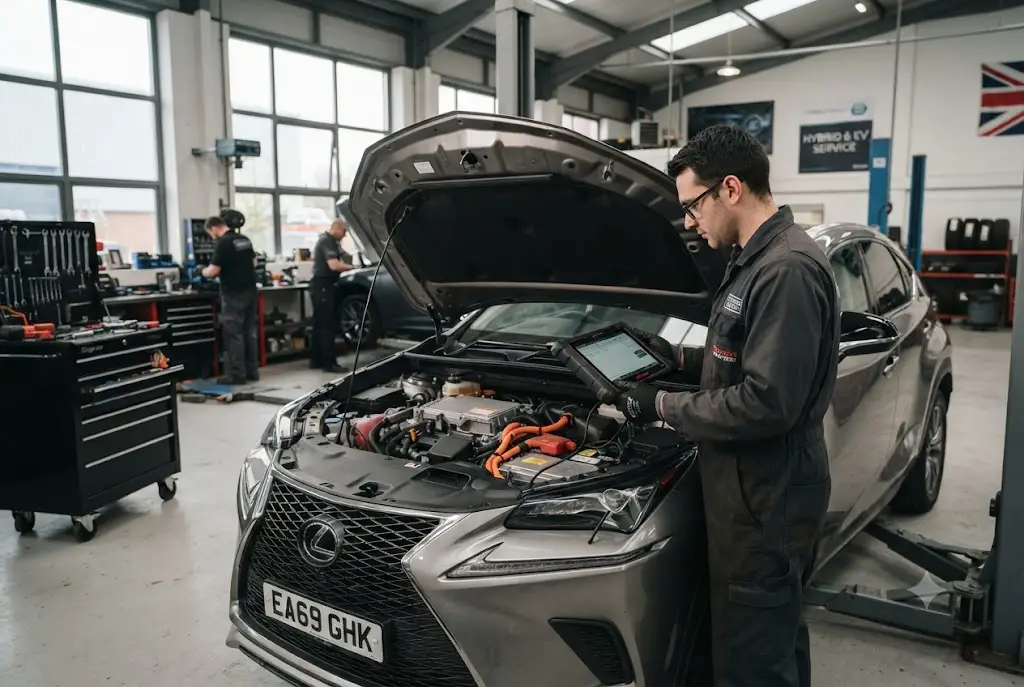
Hybrid servicing is becoming an increasingly important part of the UK automotive aftermarket as more motorists choose vehicles combining petrol or diesel engines with electric propulsion. For workshops, garage chains and vehicle owners, this transition creates new maintenance requirements while also changing expectations around technician skills, diagnostics and long-term vehicle care.
Hybrid vehicles are not simply conventional cars with a larger battery. Their combination of an internal combustion engine, electric motor, high-voltage battery and associated control systems creates a different servicing environment. At the same time, many routine maintenance requirements remain familiar, meaning garages need to understand where hybrid technology changes the service process and where traditional maintenance still applies.
What Is Hybrid Servicing?
Hybrid servicing covers the inspection, maintenance and repair of vehicles that use both an internal combustion engine and an electric propulsion system. Depending on the vehicle, this can involve checks of the petrol or diesel engine, transmission, braking system, cooling systems, electrical components, hybrid battery and associated control systems.
The exact requirements vary by manufacturer and hybrid design. Self-charging hybrids, mild hybrids and plug-in hybrids can have different architectures and service schedules, so workshops should follow the manufacturer’s requirements for the specific vehicle.
Toyota, one of the UK’s most established hybrid manufacturers, recommends servicing its hybrids every 12 months or 10,000 miles, whichever comes first, although some vehicles have different schedules. Its official hybrid service also includes checks of the hybrid system and hybrid battery.
Why Hybrid Servicing Matters in the UK
The growing presence of hybrid vehicles means the aftermarket cannot treat electrification as a niche requirement. Hybrid ownership has become part of the wider transition towards lower-emission vehicles, while many motorists continue to prefer a powertrain that combines electric assistance with the familiarity of an internal combustion engine.
For workshops, this creates an opportunity as well as a challenge. A garage that can confidently service hybrid vehicles can potentially attract customers who might otherwise restrict their servicing choices to manufacturer-authorised centres or specialist workshops.
However, capability needs to be genuine. High-voltage systems introduce safety considerations and require appropriate training, procedures and equipment. A workshop should not assume that experience with conventional vehicles automatically translates into the ability to work safely on every hybrid system.
How Hybrid Services Differ From Conventional Car Maintenance
Some hybrid maintenance tasks are broadly similar to those performed on conventional vehicles. Tyres, suspension components, brake systems, filters, fluids and other service items still require inspection according to the vehicle’s maintenance schedule.
Other areas require additional knowledge. Technicians may need to assess hybrid system components, use manufacturer-specific diagnostics and understand procedures for safely isolating high-voltage systems.
Regenerative braking also changes the way some hybrid vehicles use their braking systems. Because the electric motor can help slow the vehicle, friction brakes may experience different usage patterns from those on a conventional car. Toyota notes that hybrid vehicles can experience reduced brake-pad wear compared with conventional vehicles.
This does not mean brake inspections should be neglected. Instead, it highlights why hybrid maintenance needs to be based on the vehicle’s actual condition and manufacturer service requirements.
Toyota Hybrid Service as a Market Example
The Toyota hybrid service model provides a useful example of how manufacturers are responding to the changing servicing market. Toyota states that its hybrid service includes checks of the vehicle’s hybrid system and hybrid battery.
For eligible Toyota vehicles, an annual qualifying hybrid service can also provide further Hybrid Battery Extended Cover, subject to the applicable terms and conditions. Toyota says this can continue for up to 15 years when the relevant requirements are met.
This approach demonstrates how battery health checks can become part of the wider servicing relationship rather than being treated as a completely separate repair event.
For customers, the important lesson is to check exactly what a quoted hybrid service includes. Different providers may use similar terminology while offering different inspection scopes, warranty arrangements or additional checks.
Hybrid Maintenance Beyond the Battery
One of the most common misconceptions about hybrid vehicles is that servicing is mainly about the battery. In reality, hybrid ownership still involves many conventional maintenance requirements.
The petrol engine in a hybrid vehicle still needs appropriate maintenance. Depending on the model, this can include engine oil and filter changes, coolant checks, air filters, spark plugs and other scheduled replacement items.
Tyres remain important because the vehicle’s weight, power delivery and driving characteristics can influence tyre wear. Suspension, steering and braking components also require regular inspection.
The hybrid system therefore adds another layer to conventional maintenance rather than completely replacing it.
Hybrid Battery Lifecycle and Servicing
The hybrid battery is one of the components that generates the most questions from owners. Battery technology, vehicle design, climate, usage patterns and manufacturer specifications can all affect battery performance over time.
Routine servicing should not automatically be interpreted as a prediction of when a battery will need replacement. Instead, qualified technicians can assess the system and identify faults or abnormal performance when appropriate.
For example, Toyota’s hybrid service process includes a hybrid battery check. Its battery-care programmes also demonstrate the growing importance of documented battery health assessments in long-term hybrid ownership.
Owners should therefore keep service records and follow the maintenance schedule rather than waiting for a noticeable problem before seeking professional assistance.
What Hybrid Garages Need to Invest In
The expansion of hybrid ownership creates new requirements for service providers. A modern workshop may need more than traditional mechanical tools to work confidently with electrified vehicles.
Technician Training
Training is one of the most important investments. Technicians need to understand hybrid architectures, high-voltage safety, diagnostic procedures and manufacturer-specific systems.
The appropriate level of training depends on the work being undertaken. Workshops should ensure that staff are competent for the specific tasks they perform rather than assuming that general automotive experience is sufficient.
Diagnostic Equipment
Modern hybrids rely heavily on electronic control systems. Suitable diagnostic equipment can help technicians identify faults and understand the condition of different components.
As vehicle software becomes more important, access to accurate technical information is also becoming a significant part of workshop capability.
High-Voltage Safety Equipment
Hybrid vehicles contain high-voltage components that require appropriate safety procedures. Workshops working on these systems need suitable protective equipment, isolation procedures and controlled working practices.
This creates a meaningful distinction between a garage that simply services hybrid vehicles according to routine schedules and one that is equipped to undertake more complex hybrid repairs.
Hybrid Ownership and Customer Expectations
Hybrid owners often have different questions from drivers of conventional petrol or diesel vehicles. They may want to understand battery health, expected running costs, regenerative braking, service intervals and the implications of long-term ownership.
Clear communication can therefore become a competitive advantage for service providers. Customers are more likely to trust a workshop that explains what has been checked, identifies necessary work and distinguishes urgent repairs from routine recommendations.
Digital service reports and vehicle health checks can support this process. Toyota, for example, describes electronic vehicle health checks and digital service management as part of its customer experience.
This trend is particularly relevant to the wider automotive service companies market, where technical expertise and customer experience increasingly influence competitive positioning.
Hybrid Servicing Costs and What Affects Them
The cost of hybrid servicing varies according to the vehicle, manufacturer, age, mileage, service level and provider. It is therefore difficult to give one price that accurately represents the entire UK hybrid market.
Routine hybrid maintenance does not necessarily mean that every service will be significantly more expensive than servicing a conventional vehicle. Some manufacturers actively promote competitive service pricing for their hybrid models.
Toyota, for example, publishes fixed-price servicing for several hybrid models. Its current published pricing lists intermediate and full service levels for models such as the Corolla, Prius, Toyota C-HR and RAV4, with prices depending on the vehicle and service type.
However, customers should distinguish routine servicing from unexpected repairs. A diagnostic investigation, cooling-system issue, electrical fault or major component replacement can create costs beyond a scheduled service.
Independent Workshops vs Authorised Hybrid Service Centres
Hybrid owners can potentially choose between manufacturer-authorised centres, independent garages with suitable hybrid expertise and larger workshop networks offering hybrid services.
Authorised centres may have direct access to manufacturer systems, specialist training and brand-specific technical information. This can be valuable when dealing with complex faults or vehicles still covered by particular manufacturer programmes.
Independent workshops can compete through convenience, local relationships and potentially different pricing structures. However, customers should verify that the garage has appropriate hybrid qualifications, equipment and experience before booking specialist work.
For routine servicing, the most important question is not simply whether a business advertises itself as a hybrid garage. Owners should ask what hybrid-specific checks are included and whether the technicians are trained for the required work.
How Garage Chains Are Responding to Hybrid Demand
National garage networks are also adapting as the vehicle parc becomes more electrified. Their scale can make investment in training, diagnostic equipment and standardised processes easier to distribute across multiple locations.
However, capability can still vary between branches. A national brand may have a broad hybrid programme while a particular location may have limitations regarding the services it can perform.
This is why consumers should confirm the capabilities of the specific workshop before booking specialist hybrid work. The wider garage chains market is likely to see hybrid expertise become an increasingly important part of competitive differentiation.
Future Servicing Demand for Hybrid Vehicles
Hybrid servicing demand is likely to remain important as existing hybrid vehicles continue to age and move through different stages of ownership.
A vehicle does not stop requiring maintenance simply because it uses an electric motor. In fact, as the number of older hybrids increases, workshops may encounter a broader range of servicing and repair requirements.
This could create opportunities for independent specialists and national networks that develop strong hybrid capabilities. Businesses able to diagnose hybrid systems accurately and explain repair options clearly may be better positioned to build long-term relationships with owners.
At the same time, the growing number of battery-electric vehicles will create another distinct aftermarket opportunity. Hybrid and electric servicing share some technical requirements, but they should not be treated as identical categories.
The next stage of this transition is therefore closely connected to the developing EV servicing market, where battery diagnostics, high-voltage systems and specialist technician skills will become increasingly important.
What Hybrid Owners Should Ask Before Booking a Service
Before choosing a workshop, hybrid owners can ask several straightforward questions.
- Does the workshop regularly service the specific hybrid make and model?
- Are technicians trained to work on the vehicle’s hybrid system?
- What hybrid-specific checks are included in the quoted service?
- Is a hybrid battery health check included?
- Does the workshop have appropriate diagnostic equipment?
- Are manufacturer service requirements being followed?
- Will the customer receive a clear record of the work completed?
These questions can help separate genuine hybrid capability from a general garage that simply accepts hybrid vehicles for conventional maintenance.
The Future of Hybrid Servicing in the UK
The future of hybrid servicing will be shaped by both vehicle technology and the changing composition of the UK vehicle parc. Workshops will need to maintain conventional mechanical expertise while developing stronger electrical and diagnostic capabilities.
Manufacturers are also likely to continue developing service programmes that combine routine maintenance with battery health checks, connected vehicle information and digital service records.
For independent providers and garage chains, this creates an opportunity to build expertise before demand becomes more complex. Investment in training, equipment and customer education can help workshops compete as hybrid vehicles become an established part of everyday motoring.
For motorists, the key takeaway is simple: hybrid vehicles still need regular maintenance, but their servicing requirements include additional systems that should be handled by appropriately trained professionals.
Conclusion
Hybrid servicing is becoming an increasingly important part of the UK automotive aftermarket. Hybrid vehicles still require familiar maintenance such as engine, tyre, brake and suspension checks, but their high-voltage electrical systems and battery technology introduce additional servicing considerations.
Toyota’s hybrid service model demonstrates how battery health checks and ongoing battery-care programmes can become part of long-term ownership. Meanwhile, independent garages and national networks have an opportunity to develop specialist capabilities as hybrid vehicles move through increasingly diverse stages of their ownership lifecycle.
For owners, choosing the right service provider means looking beyond price. Technician training, diagnostic capability, hybrid-specific checks, service records and manufacturer requirements all deserve consideration. As electrification continues, these capabilities will also provide a foundation for the wider evolution of the UK automotive service market.
