

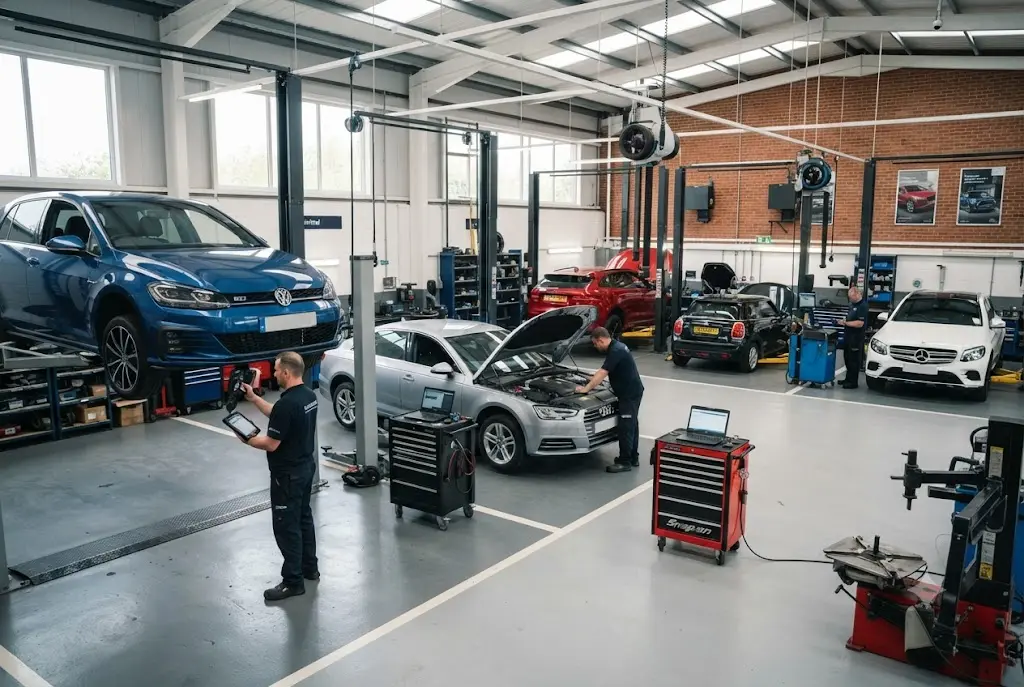
Automotive service companies form a diverse part of the UK vehicle aftermarket, ranging from independent garage groups and specialist workshops to authorised service centres, national workshop networks and automotive franchises. For motorists, fleet operators and industry observers, understanding how these businesses differ is important when assessing service coverage, customer value, operational scale and long-term market positioning.
The UK aftermarket is not dominated by one single type of provider. Instead, it combines large networks with thousands of smaller businesses, creating a highly competitive environment where convenience, technical capability, pricing, brand trust and service quality all influence customer choice.
What Are Automotive Service Companies?
Automotive service companies are businesses that provide vehicle maintenance, repair, inspection, servicing and related aftermarket services. Their operating models can vary considerably. Some operate as independent businesses, while others belong to larger workshop networks, manufacturer-approved programmes or franchise systems.
Typical services can include routine vehicle servicing, MOT preparation and testing, brake work, tyre fitting, diagnostics, suspension repairs, exhaust work, air-conditioning servicing and general mechanical repairs. Increasingly, service providers also need to support vehicles equipped with advanced driver assistance systems, sophisticated electronics and electrified powertrains.
This variety makes simple comparisons based only on branch numbers or brand recognition misleading. A meaningful assessment should consider the type of vehicles served, geographic coverage, technical capabilities, customer proposition and the ability to adapt as the vehicle parc changes.
Automotive Service Companies and the UK Aftermarket
The UK has a broad aftermarket infrastructure supporting millions of vehicles. Recent industry research from the Society of Motor Manufacturers and Traders highlights the scale and diversity of the sector, including independent chains, manufacturer-approved repairers, single-site workshops, franchised workshops and specialist providers.
That diversity creates both competition and choice. Independent operators can compete through local relationships, flexible service and potentially lower overheads, while larger networks can offer broader geographic coverage, established processes, purchasing scale and recognised branding.
For businesses conducting market share analysis, therefore, the UK aftermarket should be viewed as a collection of overlapping service models rather than a straightforward contest between a few national brands.
Independent Garage Groups vs Larger Networks
Independent garage groups occupy an important position within the UK service market. Some began as individual workshops and expanded into multiple locations, while others developed through acquisitions, partnerships or organised network models.
Their main advantage is often flexibility. Independent businesses may be able to tailor services to local demand, build long-term relationships with customers and respond quickly to changing vehicle requirements. They can also serve drivers who want alternatives to manufacturer-affiliated servicing.
However, scale can provide advantages of its own. Larger workshop networks may benefit from central purchasing, standardised operating procedures, shared marketing, training programmes and broader technology investments.
For benchmarking purposes, the comparison should therefore look beyond the number of sites. Analysts should examine location density, service breadth, technician capability, customer retention, pricing strategy and investment in diagnostic equipment.
How Authorised Service Centres Compete
Authorised service centres operate closely with vehicle manufacturers or their approved dealer networks. Their proposition is often built around brand-specific expertise, manufacturer procedures, approved parts and access to systems designed for particular vehicle models.
This model can be especially attractive for newer vehicles, premium models and customers who place a high value on manufacturer-aligned servicing. Authorised centres may also have strong relationships with customers during warranty and vehicle ownership periods.
At the same time, independent service providers remain an important alternative for motorists seeking greater choice. The competitive balance can change as vehicles become older, warranties expire and owners become more sensitive to servicing costs.
This makes vehicle age a significant factor when assessing the competitive position of different automotive service companies.
Workshop Networks and Automotive Franchises
Workshop networks provide another important operating model. Instead of every location necessarily being owned and operated centrally, a network can connect independent businesses through common branding, technical support, training, purchasing arrangements or customer programmes.
Automotive franchises take the concept further by providing businesses with an established brand and operating framework. Depending on the franchise, this can include marketing support, training, equipment guidance, supplier relationships and standardised customer processes.
For customers, network and franchise models can provide a balance between local accessibility and national brand recognition. For operators, they may provide tools for competing in a market where digital discovery and customer expectations are becoming increasingly important.
The structure of these networks is also relevant when evaluating the future UK garage chain landscape, particularly as established operators continue to compete with independent workshops and specialist providers.
Key Metrics for Benchmarking Automotive Service Companies
A useful benchmarking framework should combine quantitative and qualitative measures. Branch count is an obvious starting point, but it should never be the only metric.
Geographic Coverage
Location coverage shows how easily customers can access a provider. National networks may have an advantage when serving motorists who travel frequently or fleet operators that need consistent support across multiple regions.
Service Capability
The range of services offered can reveal how well a company is positioned to capture different customer needs. Businesses offering diagnostics, tyres, brakes, servicing, MOT-related work and specialist repairs may have more opportunities to retain customers throughout the ownership cycle.
Technical Investment
Modern vehicles increasingly require advanced diagnostic equipment and specialist technician training. Benchmarking should therefore consider investment in tools, software, training and facilities rather than relying solely on traditional service capacity.
Customer Proposition
Price, convenience, appointment availability, warranty considerations, communication and customer experience all influence purchasing decisions. A company with fewer locations can still compete effectively if its customer proposition is strong and differentiated.
Digital Presence
Online booking, service information, location finders, customer reviews and digital communication have become important parts of the modern aftermarket journey. Digital capability can make it easier for motorists to compare service providers before making an appointment.
Why Market Share Analysis Needs More Than Branch Counts
Market share analysis in automotive servicing can become misleading when it treats every workshop location as equivalent. A large national network, a manufacturer-authorised centre and a specialist independent garage may operate at very different scales and serve different customer segments.
A stronger analysis considers revenue potential, service volumes, geographic concentration, vehicle mix and customer segments. It can also examine how providers compete across different stages of the vehicle lifecycle.
For example, a company focused heavily on newer vehicles may have a different competitive profile from one specialising in older cars. Likewise, a tyre-focused business may overlap with general repair providers for some services but compete differently for routine maintenance.
This segmented approach produces a more useful picture of competitive positioning than simply ranking companies by the number of workshops they operate.
Technology Is Changing Automotive Service Providers
Technology is becoming increasingly important across the aftermarket. Connected vehicles, sophisticated diagnostics, advanced safety systems and electrified powertrains are changing the skills and equipment required by workshops.
The shift is particularly important for businesses planning long-term investment. SMMT research has highlighted significant investment by UK workshops in training, equipment and capabilities needed to maintain newer vehicle technologies.
Electrification is one part of this transition. The growing number of hybrid and electric vehicles means service providers must increasingly understand high-voltage systems, battery-related issues, specialist diagnostics and new maintenance requirements.
This development connects directly with the wider cluster topics of hybrid servicing trends and EV servicing, both of which are likely to influence workshop investment and future service demand.
What Makes a Strong Automotive Service Company?
There is no single formula for success. A strong automotive service company needs to match its operating model with the needs of its target customers.
For a local independent business, trust, technical competence and personal service may be central advantages. A national network may instead compete through accessibility, consistency and brand recognition. An authorised centre can emphasise manufacturer expertise, while a specialist provider can differentiate itself through deep knowledge of a particular vehicle type or service.
Successful businesses are likely to share several characteristics: capable technicians, appropriate equipment, transparent communication, efficient workshop processes and the ability to adapt as vehicles become more technologically advanced.
The Future Competitive Landscape
The UK automotive service market is likely to remain highly fragmented while continuing to evolve. Independent garages, national networks, authorised service centres, franchises and specialist providers will continue competing for different parts of the vehicle servicing journey.
At the same time, changing vehicle technology will reshape competitive advantages. Businesses that invest in technician skills, diagnostics and new service capabilities may be better positioned as the vehicle parc changes.
Digital customer journeys will also matter. Motorists increasingly expect convenient ways to discover providers, compare options, request appointments and communicate with workshops. This creates opportunities for companies that combine physical service capability with a strong digital experience.
For industry analysts, investors and automotive businesses, the most useful benchmarking approach is therefore one that combines scale, coverage, technical capability, customer proposition and adaptability. Looking at all of these factors provides a clearer understanding of where different automotive service companies sit within the UK’s broader aftermarket ecosystem.
Conclusion
Automotive service companies operate across a complex UK aftermarket that includes independent garage groups, authorised service centres, workshop networks, franchises and specialist providers. Their competitive strengths differ, making detailed benchmarking more useful than simple rankings based on location count.
As vehicle technology evolves, the companies best positioned for long-term growth will need to combine service quality and customer convenience with investment in technical skills, diagnostics and emerging vehicle technologies. For anyone assessing the sector, these factors provide a stronger foundation for understanding competitive positioning and future servicing demand.
