

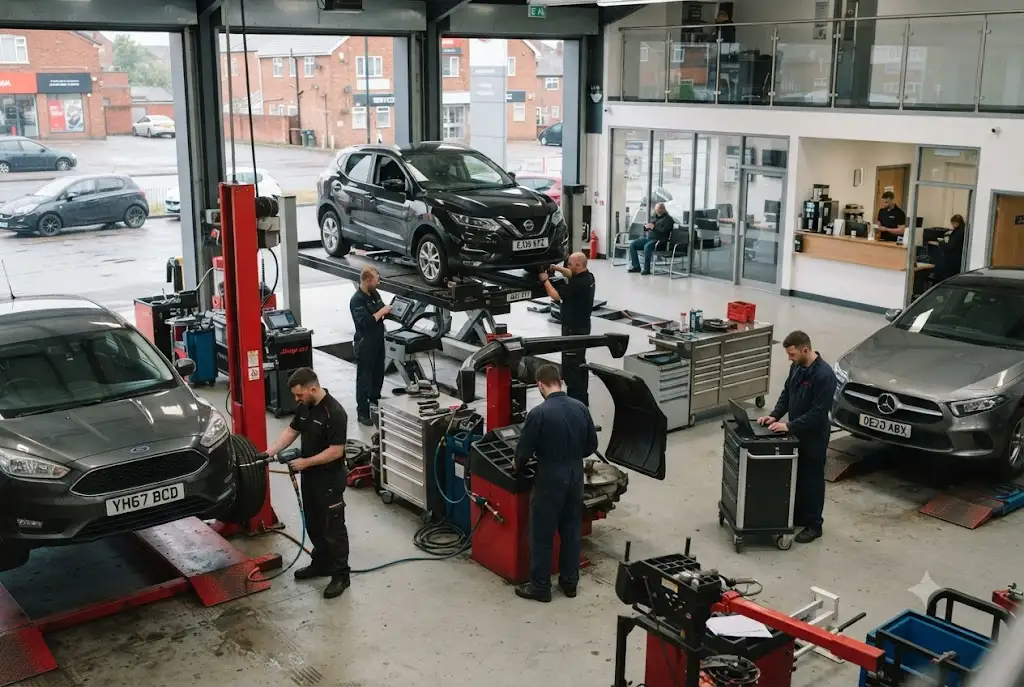
Garage chains play a significant role in the UK automotive aftermarket, giving motorists access to established brands for tyres, MOT testing, servicing, repairs, bodywork and other vehicle maintenance needs. Unlike a single independent workshop, a national or regional chain can offer broader coverage, standardised processes and a familiar brand across multiple locations.
However, garage chains are not all built around the same business model. Some have developed from tyre retail, others focus heavily on general vehicle servicing, while specialist networks concentrate on areas such as accident repair. Understanding these differences helps motorists, fleet operators and automotive businesses make more informed comparisons.
What Are Garage Chains?
Garage chains are groups of automotive service locations operating under a common brand, ownership structure or network arrangement. Their branches may provide similar services and follow shared operational standards, although the exact capabilities of individual locations can vary.
The largest networks compete with independent garages by offering convenience and recognisable branding. A customer travelling across the UK may find it easier to use a familiar chain than to identify a new independent workshop in every town.
For the automotive industry, garage chains also represent an important route for delivering aftermarket services at scale. Their networks can cover routine maintenance as well as more specialised requirements, depending on the business.
How UK Garage Chains Compete
Competition between garage chains is not based solely on price. Location coverage, appointment availability, service range, technician skills, online booking, customer experience and brand reputation can all affect consumer decisions.
Some networks have a particularly strong presence in tyres and fast-fit services. Others have broader mechanical capabilities, while body repair networks operate around a different customer journey following accidents and insurance claims.
This makes it useful to compare national garage networks according to their core strengths rather than treating every branch as an identical service provider.
Kwik Fit: A Major UK Fast-Fit Network
Kwik Fit is one of the UK’s most recognisable automotive service chains, with more than 600 centres across the country. Its service portfolio extends beyond tyres to include MOT testing, servicing, brakes, exhausts, batteries, suspension and air-conditioning services. :contentReference[oaicite:0]{index=0}
Its large physical network is one of its most visible competitive advantages. Customers can use the company’s centre locator to find branches across England, Scotland, Wales and Northern Ireland, while online booking provides another route into the service journey. :contentReference[oaicite:1]{index=1}
Kwik Fit also illustrates how traditional fast-fit businesses are expanding their service proposition. The company now supports a wider range of maintenance requirements rather than relying exclusively on tyre sales.
For motorists, the attraction is straightforward: a familiar brand, substantial geographic coverage and a broad range of common maintenance services.
National Tyres & Autocare and the Broader Fast-Fit Market
National Tyres & Autocare is another established name in the UK aftermarket. Its position illustrates how tyre-focused businesses can develop broader vehicle maintenance propositions as customer expectations change.
Tyres remain an important entry point into the aftermarket because they are safety-critical, regularly replaced and relatively easy for consumers to compare. However, customers visiting for tyres may also require brakes, servicing, batteries, MOT-related work or other repairs.
This creates opportunities for garage chains to increase the range of services provided to an existing customer base. The challenge is maintaining trust while expanding beyond a network’s traditional specialism.
ATS Euromaster: Combining Tyres and Vehicle Services
ATS Euromaster occupies another important position within the UK tyre and automotive service market. The business is associated with tyre services as well as vehicle maintenance, making it relevant to motorists looking for a broader service provider.
For a network of this type, technical capability and product knowledge are particularly important. Tyre selection increasingly involves more than choosing a size and price. Vehicle specifications, seasonal conditions, performance requirements and manufacturer recommendations can all influence the appropriate choice.
The wider lesson for garage chains is that specialist expertise can remain an important competitive advantage even when companies expand into additional services.
Halfords and the Evolution of the Autocentre Model
Halfords has built a substantial presence in the UK automotive aftermarket through its retail and autocentre operations. Its automotive proposition covers areas such as tyres, MOT testing, servicing and vehicle maintenance.
The Halfords model demonstrates the potential advantage of combining automotive retail with workshop services. Customers can encounter the brand through products, accessories and maintenance services, creating multiple points of contact throughout vehicle ownership.
For garage chains, this type of integration can strengthen customer awareness. A business that already has a recognised consumer brand may find it easier to introduce additional automotive services than a new entrant starting without an established customer base.
Protyre and Regional-to-National Expansion
Protyre represents another important name in the UK tyre and automotive service landscape. Its network approach demonstrates how businesses can develop significant coverage while retaining a strong connection to tyre and workshop services.
Protyre’s positioning is particularly relevant when analysing the development of national garage networks. The UK aftermarket contains many businesses that began with specialist regional operations and expanded their footprint over time.
For consumers, wider coverage can improve convenience. For the operator, however, expansion brings challenges involving recruitment, technician training, equipment investment, quality control and consistent customer service.
Fix Auto: A Different Type of Garage Network
Fix Auto occupies a different position from traditional fast-fit chains because its network is strongly associated with vehicle body repair and accident repair.
This distinction is important when comparing garage chains. A customer searching for a tyre replacement has very different requirements from someone whose vehicle has suffered collision damage. Body repair involves specialist equipment, repair processes, paint systems and often interaction with insurers.
Fix Auto therefore illustrates how network scale can be built around a specific automotive service category rather than a broad mechanical workshop proposition.
Its network model is also useful for understanding how specialist providers can achieve national visibility while maintaining locally operated repair facilities.
Fast Fit Autocentres and the Independent Alternative
Fast Fit Autocentres and similar operators compete in a market where convenience and rapid maintenance are important considerations. The fast-fit concept is generally associated with services that can be completed efficiently, including tyres, brakes, exhaust-related work and other routine maintenance.
However, consumers should remember that the capabilities of individual locations can differ. Before booking, it is sensible to check whether the specific branch provides the service required, particularly for specialist diagnostics, hybrid systems or newer electric vehicles.
This is one area where garage chains increasingly overlap with the wider market of automotive service companies. A network may have a strong brand presence while individual sites still need appropriate equipment and trained technicians for specific vehicle technologies.
Garage Chains vs Independent Garages
Choosing between a national chain and an independent garage is not simply a question of which model is better. Each can offer advantages depending on the customer’s priorities.
Garage chains can provide brand familiarity, multiple locations, online booking and standardised service processes. They may also have access to central purchasing arrangements, training programmes and broader technical resources.
Independent garages can offer a more localised service and may specialise in particular makes, models or repair categories. A well-established independent workshop can also develop strong relationships with repeat customers.
The right choice depends on the vehicle, repair requirement, location, budget and the customer’s confidence in the provider.
Why Location Still Matters for Garage Chains
One of the strongest advantages of a national garage network is geographic reach. A large number of branches can make a service provider accessible to customers who move between towns or cities.
Location can also matter for fleet operators. Businesses managing multiple vehicles may prefer service providers capable of supporting drivers across different regions. Consistent booking systems and national coverage can simplify fleet maintenance administration.
For individual motorists, however, the nearest branch is not necessarily the best option. Service capability, reviews, availability and technical expertise should all be considered alongside distance.
Digital Booking Is Changing Garage Networks
Garage chains increasingly use digital systems to make the customer journey easier. Online booking allows motorists to enter vehicle information, choose a service and check availability without relying entirely on telephone enquiries.
Kwik Fit, for example, provides online booking for tyres, MOT testing and servicing, while some services require customers to contact their local centre directly. :contentReference[oaicite:2]{index=2}
This digital layer has become increasingly important because customers often compare several providers before making an appointment. A clear website, transparent information and convenient booking process can influence whether a customer chooses one network over another.
How Vehicle Technology Is Changing Garage Chains
The biggest long-term challenge for garage chains may not be competition between brands but the changing technology of the vehicles they service.
Modern cars increasingly rely on sophisticated electronics, advanced driver assistance systems and electrified powertrains. These developments require appropriate diagnostic equipment and technician training.
Hybrid and electric vehicles are particularly relevant. Garage networks need to understand high-voltage systems, battery-related diagnostics and manufacturer-specific servicing requirements as the UK vehicle parc becomes more electrified.
This creates a direct connection with the future hybrid servicing market and EV servicing market, where technical capability is likely to become an increasingly important competitive factor.
What Should Customers Compare?
When comparing garage chains, motorists should look beyond promotional prices. A low headline price may not represent the complete cost of a service or repair.
Service Availability
Check whether the chosen branch actually provides the required service. Network-wide branding does not guarantee identical capabilities at every location.
Technical Expertise
For newer, hybrid or electric vehicles, ask whether the workshop has the appropriate equipment and trained technicians for the specific job.
Parts and Warranty Considerations
Ask what parts are being used and whether any warranty or guarantee applies to the work. This can be particularly important for significant repairs.
Customer Reviews
Reviews can provide useful context about communication, appointment handling and customer experience. They should be considered alongside the actual service requirement rather than used as the only decision-making factor.
Total Cost
Compare the complete quoted cost, including labour, parts and any additional charges. If extra work is recommended, ask why it is necessary and whether it is urgent or can be scheduled later.
The Future of National Garage Networks
National garage networks are likely to remain an important part of the UK automotive aftermarket. Their scale gives them advantages in branding, purchasing, training, technology investment and customer reach.
However, scale alone will not guarantee long-term success. The most competitive networks will need to combine physical accessibility with digital convenience and credible technical expertise.
Electrification will make this particularly important. A network that can support traditional mechanical maintenance while developing hybrid and EV capabilities may be better placed to serve customers across the vehicle ownership lifecycle.
At the same time, independent garages will continue to compete through specialist knowledge, local reputation and personalised service. This means the UK market is likely to remain diverse rather than becoming dominated by a single garage model.
Conclusion
Garage chains provide motorists with an accessible alternative to individual workshops, covering everything from tyres and MOTs to servicing, mechanical repairs and specialist bodywork. Kwik Fit, National Tyres & Autocare, ATS Euromaster, Halfords, Protyre, Fix Auto and Fast Fit Autocentres demonstrate the variety of models operating across the UK.
The strongest comparison is not simply based on branch numbers or brand recognition. Customers should consider service capability, technical expertise, convenience, pricing, reviews and the suitability of a particular branch for their vehicle.
As hybrid and electric vehicles become increasingly important, garage chains will also need to invest in skills, equipment and diagnostics. Their ability to adapt to changing vehicle technology could ultimately become just as important as their existing geographic coverage.
