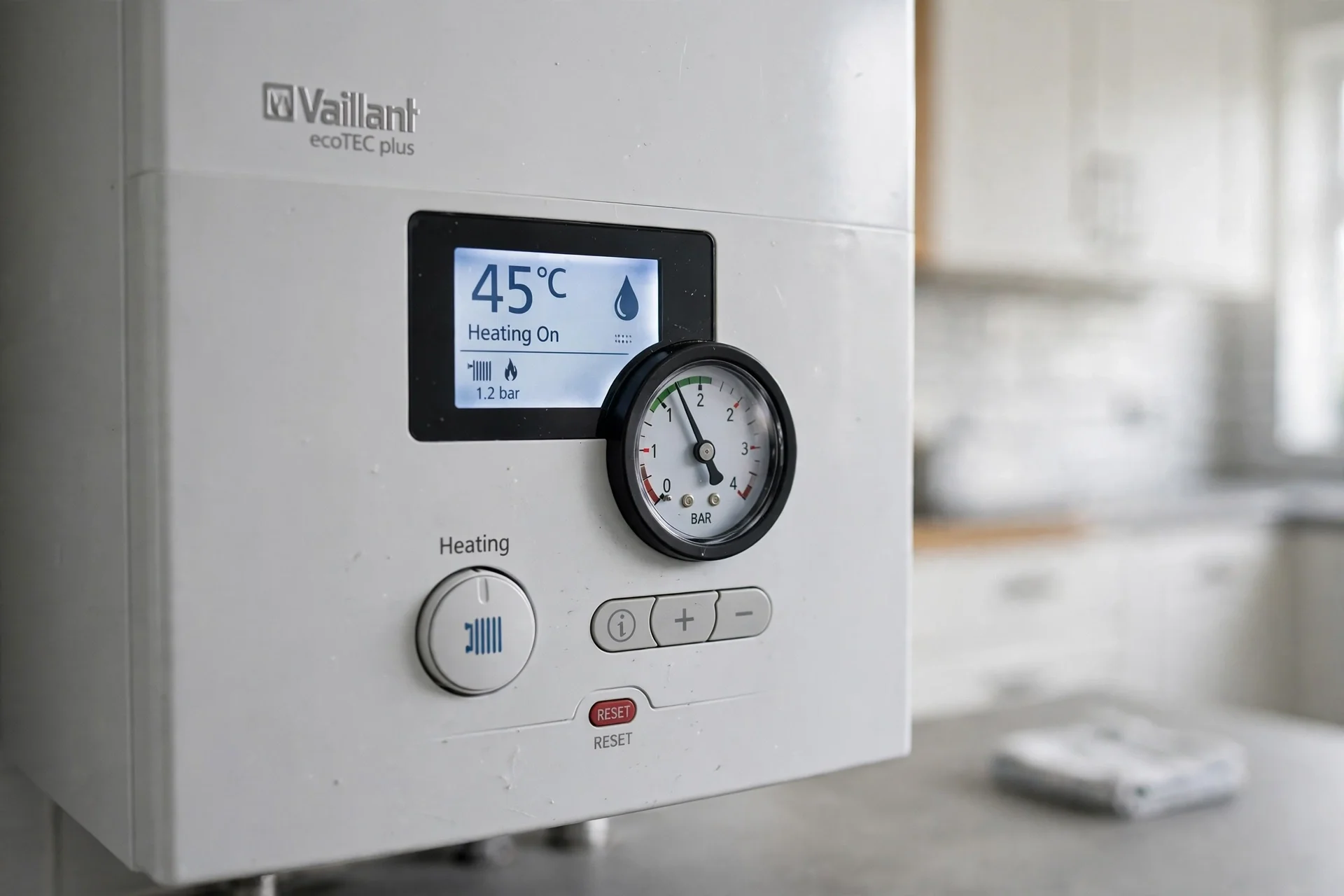
The heating stops and a short code appears on the boiler display. It might be a letter followed by two digits, a flashing light or a number you have never seen. Does it mean a small glitch or a serious fault?
Boiler fault codes are messages from the boiler’s own control board. Each code names a check that failed, such as a flame that was not detected, a pressure that is too low or a sensor that gave an odd reading. The code does not give a repair, but it points to the area that needs attention. Below we look at how codes work, what to record and what is safe for you to do.
How boiler fault codes work
A modern boiler runs a series of checks every time it starts. It confirms that water pressure is in range, that the fan runs, that the gas ignites, that the flame stays lit and that temperatures stay within limits. If a check fails, the boiler stops, or locks out, and shows a code.
Codes differ from one maker to another, and sometimes from one model to another by the same maker. The same code can mean different things on two boilers. For that reason, the manual for your exact model is the only reliable key. If you no longer have it, the model name on the front panel usually lets you find a copy online.
The main families of faults
Although the codes differ, the faults fall into a few families.
- Ignition faults. The boiler tries to light and fails, which can come from no gas supply, a dirty electrode or a faulty gas valve.
- Flame loss. The flame lights and then goes out, often a sign of a sensor problem or a flue that cannot clear the gases.
- Water pressure faults. Pressure is too low or too high, which can come from a leak or a recent top-up.
- Overheating. Temperatures rise too far because of poor flow, a failing pump or scale.
- Fan and flue faults. The fan does not run or the flue is blocked.
- Sensor and board faults. A temperature sensor or the control board sends wrong data.
Knowing the family tells you what kind of problem to expect, even if you do not know the exact repair.
Reading a code in practice
Take a boiler that stops heating on a cold morning and shows a low pressure code. The family tells you that the system has lost water or is not holding its pressure. A small drop over many months can be normal. A drop every few days is not, because the water has to be going somewhere, possibly through a leaking radiator valve, a joint or the pressure relief pipe.
Now take a boiler that shows an ignition code only on the coldest nights. The timing is the clue. On some boilers a frozen condensate pipe outside produces a lockout that looks like an ignition fault, so a code that appears only in a frost points to the exposed pipe rather than to a failed part inside the casing. The same code on a mild day would point somewhere else.
What to write down
Before you reset anything, note the code exactly as shown, the time, the room temperature and what the boiler was doing. Was it heating radiators or running hot water? Did a tap run at the time? Did the pressure gauge look normal?
Take a photograph of the display and the pressure gauge. This information shortens an engineer’s visit, because the first part of any fault finding is working out when and why the problem appears.
A short note on your phone works as well as a notebook. What matters is that the details are written down before the reset, because a reset clears the display and the clue that came with it.
Safe checks before you call
Some faults have a simple cause that you can check without opening the boiler.

- Look at the pressure gauge. If it is below the range in the manual, the boiler may need topping up through the filling loop.
- Check the gas supply. Does the hob work? If not, the supply may be off.
- Check that the condensate pipe outside is not frozen in cold weather.
- Make sure the thermostat and timer are calling for heat.
If one of these is the cause, a single reset may restore normal running. Use the reset button once, and wait a few minutes. A boiler that locks out again with the same code has a real fault.
Boiler code or heating control problem?
Not every cold house is a boiler fault. If the display shows no code and the radiators stay cold, the cause may sit in the controls, such as the programmer, the room thermostat, a motorised valve or flat batteries in a wireless thermostat. Changing the batteries and confirming that the timer is set to on are quick and safe checks.
A useful comparison is hot water. If the taps run hot but the radiators do not, the boiler is probably working and the problem lies in the heating circuit, for example a stuck valve or trapped air. If neither works and a code is showing, the boiler itself is the likely source. This test is a guide and not a diagnosis, because some boilers share one fault between heating and hot water.
Why repeated resets are a bad idea
It is tempting to press reset many times. Each reset starts another ignition attempt. With a gas fault, that can mean repeated attempts to light gas that does not burn properly. With an overheat fault, it means running the boiler again before the cause is fixed.
Treat a code that returns within a day as a message that needs action. Stopping early is the safe choice.
What an engineer will want to know
A call goes faster when you can answer a few plain questions. An engineer will usually ask about these four things before arriving:
- The exact code and whether it changes between attempts.
- When it first appeared and whether it follows a pattern, such as cold mornings or after the hot tap runs.
- The pressure reading before and after any top-up.
- Any recent work on the heating, or any sign of water around the boiler or pipes.
Notes like these turn a general complaint into a short list of likely causes, which saves time on the day.
When to stop and call an engineer
Do not open the casing of a gas boiler. Call a Gas Safe registered engineer for any fault involving gas, the flue, the fan or the control board. If you smell gas, leave the property and call the National Gas Emergency Service on 0800 111 999.
If a code keeps coming back, a guide on what causes low boiler pressure explains one common trigger, and an engineer can look at the fault in person. Whichever engineer you choose, ask to see their Gas Safe ID card first.
Prevention
Many fault codes trace back to dirt, scale or wear that a yearly service would have found. Keep the area around the boiler clear, check the pressure gauge now and then and bleed radiators that feel cold at the top. Keep the manual in a drawer where you can find it.
A code on the display feels alarming at first, but it is also useful. It tells you where to look, and with a clear note of what you saw, an engineer can often reach the cause in one visit.
Codes and the weather
Some faults show up only in certain conditions. Frost can affect the condensate pipe, strong wind can disturb a flue, and a very cold spell makes any weak point more likely to fail. If a code appears only at certain times, say so when you describe the problem. Patterns like this save an engineer a lot of guesswork.
Keep the manual and a record
The manual for your model usually lists its fault codes and what they mean in plain terms. If it has been lost, the make and model number printed on the boiler is enough to find a copy online. Keep a short log of each fault with the date, the code and what you did. If the same code returns, the history shows whether the problem is a one-off or a repeating one.
What a reset can and cannot do
A reset clears the lockout and lets the boiler try again. It does not repair the reason the boiler stopped. If a single reset brings the heating back and the code stays away for months, a temporary cause such as a pressure dip is likely. If the code returns within days, the cause is still there and the boiler needs a proper check.